
A stablecoin is useful only when its design matches the job it is expected to perform. A token intended for a short exchange route, for example, should be evaluated differently from one used as collateral in decentralized finance or held pending a fiat redemption. The practical choice depends on backing, redemption rights, network compatibility, issuer or protocol control, liquidity at the chosen venue and the rules applicable to the user.
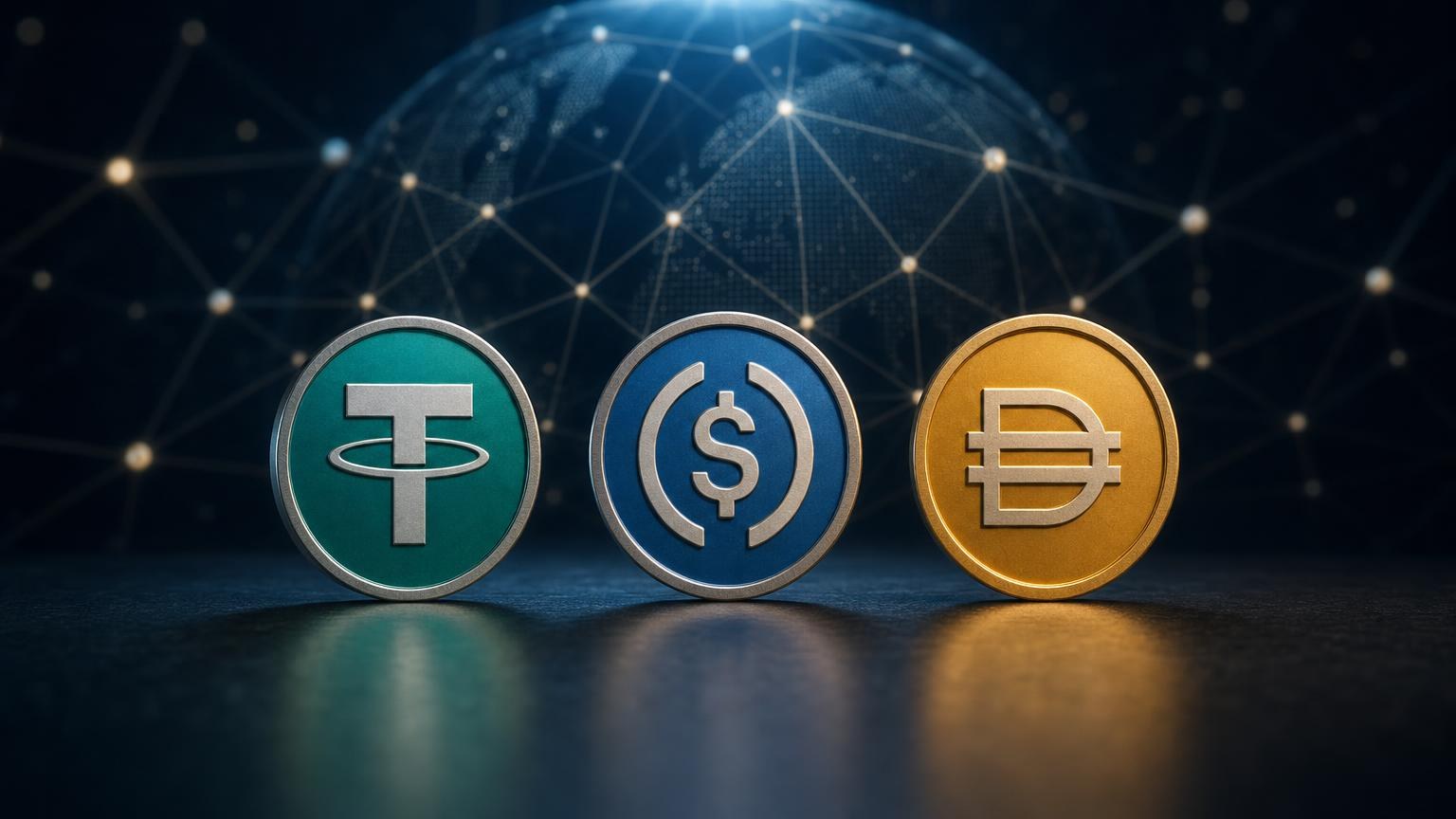
This comparison focuses on three US dollar-referenced stablecoins with meaningfully different structures: USDT, USDC and DAI. USDT and USDC rely on reserves administered by centralized issuers, while DAI is generated through a smart-contract system against approved collateral. Tether states that issued USDT is backed by its reserves and publishes periodic reserve reports; Circle describes USDC as backed by dollar-denominated reserve assets and publishes reserve information; Maker Protocol documentation describes DAI as a collateral-backed stablecoin generated against assets accepted by protocol governance. [1]
What Can Be Compared—and What Cannot
USDT, USDC and DAI can be compared because they pursue a broadly similar outcome: maintaining a value close to one US dollar while remaining transferable on a blockchain. The comparison becomes misleading if “stablecoin” is treated as a single risk category. Their stabilization mechanisms, user claims and failure paths are not the same.
- USDT and USDC: issuer-administered tokens supported by off-chain reserve assets. Their operation depends on reserve management, banking and custody arrangements, issuer policies, legal access to redemption and the relevant blockchain implementation.
- DAI: a protocol-administered token backed through collateral positions and stabilization mechanisms. Its risk profile includes smart contracts, governance, collateral quality, price oracles and liquidation infrastructure. [2]
Commodity-backed tokens, yield-bearing instruments and stablecoins that rely primarily on algorithmic supply adjustments are outside this matrix. Their economic purpose and claim structure differ too much for a direct operational comparison. A displayed market price near one dollar does not make two tokens equivalent.
Stop Criteria: When a Stablecoin Does Not Fit
Before comparing convenience or market availability, eliminate any option that fails a non-negotiable requirement. These stop criteria prevent a familiar ticker or apparently low fee from overriding a structural incompatibility.
- The receiving platform does not support the exact token and network. The same ticker may exist on several networks, while a wallet, exchange or payment recipient may accept only one implementation. Unsupported deposits can be delayed or lost.
- The destination accepts only native tokens, but the available asset is bridged or wrapped. A bridged representation introduces an additional contract, custodian or bridge dependency and may not be recognized as the issuer’s native token.
- Direct fiat redemption is essential, but the user is not eligible. Holding a stablecoin does not automatically provide unrestricted access to the issuer’s redemption service. Account status, jurisdiction, compliance checks, minimums and other conditions may apply. Circle’s terms, for example, distinguish between eligible account holders and other token holders, while Tether’s terms impose verification and eligibility requirements for direct issuance and redemption. [3]
- Address-level intervention is unacceptable. Centralized issuers may block or freeze tokens under their terms or in response to legal requirements. Both Circle and Tether document such powers. [3]
- Protocol and collateral risk is unacceptable. DAI does not remove counterparty and market dependencies; it changes their form. Its operation relies on approved collateral, governance decisions, oracle data, liquidations and functioning smart contracts.
- A temporary deviation from the dollar would make the transaction fail. A stablecoin target is not a guarantee. Secondary-market prices can move away from the reference value during liquidity stress, operational disruption or a loss of confidence.
- The asset’s legal or tax treatment is unclear for the intended use. Rules differ between countries and may depend on whether the transaction is a purchase, transfer, payment, disposal or redemption. General comparisons cannot replace local professional guidance.
Decision Matrix Based on Constraints
| Criterion | Value for the task | Options that pass or are eliminated | Material limitation | What to verify before deciding |
|---|---|---|---|---|
| Stabilization model | Determines the principal source of backing and the main failure path | USDT and USDC pass when issuer-managed reserves are acceptable. DAI passes when protocol collateral and on-chain risk management are acceptable. | Reserve-backed does not mean risk-free; protocol-backed does not mean free from centralized collateral or governance dependencies. | Latest reserve disclosures, collateral composition, governing terms and any material protocol changes |
| Direct redemption requirement | Critical when the end goal is receiving dollars from the issuer rather than selling through a third party | USDT or USDC may pass only if the relevant issuer accepts the user, jurisdiction and transaction. DAI is not a direct claim on a conventional issuer-managed dollar account. | Market conversion through an exchange is not the same as contractual redemption with an issuer. | Eligibility, identity and compliance requirements, supported jurisdiction, applicable fees, limits and settlement conditions |
| Resistance to issuer-level freezing | Relevant for users evaluating control over transfers at the token-contract level | DAI may better match a requirement to avoid a conventional single issuer, but protocol governance and underlying collateral still create control dependencies. USDT and USDC are eliminated if any issuer freeze capability is an absolute stop condition. | No major stablecoin provides immunity from wallet compromise, platform restrictions, sanctions screening or legal consequences. | Current contract permissions, governance mechanisms, platform custody rules and applicable law |
| DeFi integration | Matters when the token will be supplied, borrowed, used as collateral or placed in a liquidity pool | Any of the three may pass if the exact protocol supports the exact contract on the chosen network. DAI has a protocol-native role in the Maker system. | Integration adds risks beyond the stablecoin itself: smart-contract exploits, oracle failures, liquidations, pool imbalance and governance changes. | Official protocol documentation, verified contract address, collateral parameters, audits, oracle design and withdrawal conditions |
| Exact blockchain and token contract | Determines whether the transfer can reach the destination safely | Only the asset issued or recognized on the recipient’s supported network passes. All versions on unsupported networks are eliminated, even if the ticker is identical. | Native, bridged and wrapped versions may have different issuers, redemption paths and risk assumptions. Circle’s terms explicitly distinguish official USDC from copies and wrappers. [3] | Network name, official contract address, deposit status, memo or tag requirements and whether the destination accepts native or bridged tokens |
| Secondary-market availability | Relevant for trading, exchange routes and short-term settlement | The option with sufficient availability for the specific venue and pair passes; unavailable assets or networks are eliminated. | Availability is dynamic and venue-specific. Broad circulation does not guarantee support for a particular pair, network or withdrawal route. | Current deposits and withdrawals, order-book or route liquidity, quoted rate, spread, service fee, network fee and transaction limits |
| Transparency preference | Helps assess what evidence is available about reserves or protocol state | USDT and USDC pass when the user accepts issuer-produced disclosures and third-party assurance within their stated scope. DAI passes when on-chain collateral and protocol rules better match the required verification model. | An attestation is not automatically equivalent to a full financial-statement audit. On-chain visibility also cannot eliminate legal, oracle, custody or collateral valuation risks. | Reporting date, scope, accounting basis, reserve categories, auditor or assurance provider, on-chain positions and governance-approved parameters |
| Response to market stress | Shows which mechanism is expected to defend the reference value | USDT and USDC rely primarily on reserve liquidity, issuer operations and eligible redemption. DAI relies on collateralization, liquidations, market incentives and protocol controls. | Mass redemptions can test reserve liquidity, while rapid collateral declines can stress liquidations and auctions. Regulators identify redemption and reserve-asset risks as material stablecoin concerns. [4] | Current market price, redemption status, reserve liquidity, protocol collateral health, oracle operation and any emergency announcements |
| Transaction reversibility and operational safety | Critical for any transfer where an error would be costly | None passes if the user cannot verify the address and network. Blockchain transfers should be treated as irreversible in normal operation. | An issuer’s ability to freeze tokens does not create a general chargeback mechanism. Circle’s terms state that on-chain transfers to third-party addresses are irreversible. [3] | Address, network, contract, destination status, test-transfer feasibility and protection against clipboard malware or phishing |
How Different Constraint Sets Change the Choice
Exchange Route With a Fixed Receiving Network
If the destination supports only one stablecoin contract on one network, compatibility becomes decisive. Reserve design, decentralization preferences and brand familiarity are secondary because incompatible assets cannot complete the route. The suitable option is whichever token and network the recipient currently accepts—not whichever stablecoin appears strongest in a general comparison.
Planned Redemption Into a Bank Account
When direct redemption is the objective, the decisive constraint shifts to the issuer relationship. A user must assess eligibility, account verification, jurisdiction, redemption terms and compliance review. USDT or USDC may fit this model in principle, but neither should be selected until the current conditions are checked. DAI’s on-chain collateral model does not provide the same direct issuer-redemption structure.
On-Chain Use Without a Conventional Issuer Claim
For a user prioritizing protocol-based collateral over a traditional issuer-managed reserve, DAI may be the more relevant candidate. That change does not eliminate risk: it substitutes exposure to smart contracts, governance, collateral composition, price feeds and liquidation mechanisms for a conventional issuer and reserve relationship. Maker documentation also describes emergency shutdown conditions under which the collateral value received for DAI may differ from one dollar per token. [5]
Short Holding Period Before a Crypto Purchase
Here, the primary constraints may be venue support, conversion spread and withdrawal network rather than direct redemption or long-term reserve philosophy. Those parameters are dynamic. A stablecoin that is structurally suitable can still be impractical if deposits are suspended, the required pair is unavailable or withdrawal is offered only through an incompatible network.
Changing one decisive constraint can therefore reverse the result. Requiring direct issuer redemption favors a different structure from requiring protocol-native DeFi use; requiring a specific receiving network can eliminate an otherwise acceptable asset immediately. There is no universal winner independent of route, jurisdiction and intended use.
Stable Properties Versus Dynamic Conditions
Some characteristics can be treated as relatively stable until a major redesign occurs. These include the general reserve or collateral model, the existence of an issuer or protocol governance system, the intended reference asset and the basic distinction between native and wrapped tokens.
Operational conditions require a fresh check for every transaction:
- available assets, trading pairs and exchange directions;
- supported deposit and withdrawal networks;
- token contract addresses and migration notices;
- market rate, spread and deviation from the reference value;
- service charges and blockchain fees;
- minimum and maximum transaction amounts;
- network congestion and confirmation requirements;
- issuer or platform redemption status;
- identity, source-of-funds and other compliance requirements;
- country-specific restrictions and tax treatment.
Even reserve information has a date and scope. Tether notes that its reserve reports reflect specified reporting dates and contain stated limitations, while Circle publishes current reserve and transparency materials for USDC. These disclosures should be read as dated evidence, not as permanent guarantees. [1]
Transfer and Exchange Safety Checklist
- Confirm the full asset name rather than relying only on the ticker.
- Match the sending and receiving networks exactly.
- Verify the official contract address using project documentation and a reputable blockchain explorer.
- Determine whether the token is native, bridged or wrapped.
- Check that deposits and withdrawals are currently operational at both endpoints.
- Review the entire quote, including spread, service charges and network costs, before creating the transaction.
- Read the current limits and compliance conditions for the selected direction; requirements may depend on the route and the results of compliance checks.
- Use a small test transfer when the service and economics of the transaction make it practical.
- Recheck the destination address after pasting it and before signing.
- Avoid links received through unsolicited messages, advertisements or unofficial support accounts.
- Do not assume that a previous successful route remains available today.
To apply these criteria to a real transaction, check the currently available stablecoin exchange directions before creating a request. Availability of a specific asset, pair or network should be confirmed at that moment rather than inferred from general support for the token.
Decision Rule
Start with the constraint that would make the transaction impossible or unacceptable: the receiving network, redemption eligibility, address-control model, DeFi integration or jurisdictional restriction. Eliminate every stablecoin that fails that condition. Then compare reserve or collateral design, transparency and stress behavior among the remaining options. Only after the structural choice is made should dynamic factors such as the current rate, fees, limits, processing conditions and network load determine the route.
Stablecoins reduce exposure to ordinary crypto price movements only while their stabilization mechanism works and the chosen market continues to value them near the reference asset. They do not remove depegging, issuer, reserve, collateral, governance, smart-contract, phishing, compliance or transfer-error risks. The correct choice is therefore the token that satisfies the specific constraints with understood trade-offs—not the token with the most familiar name.